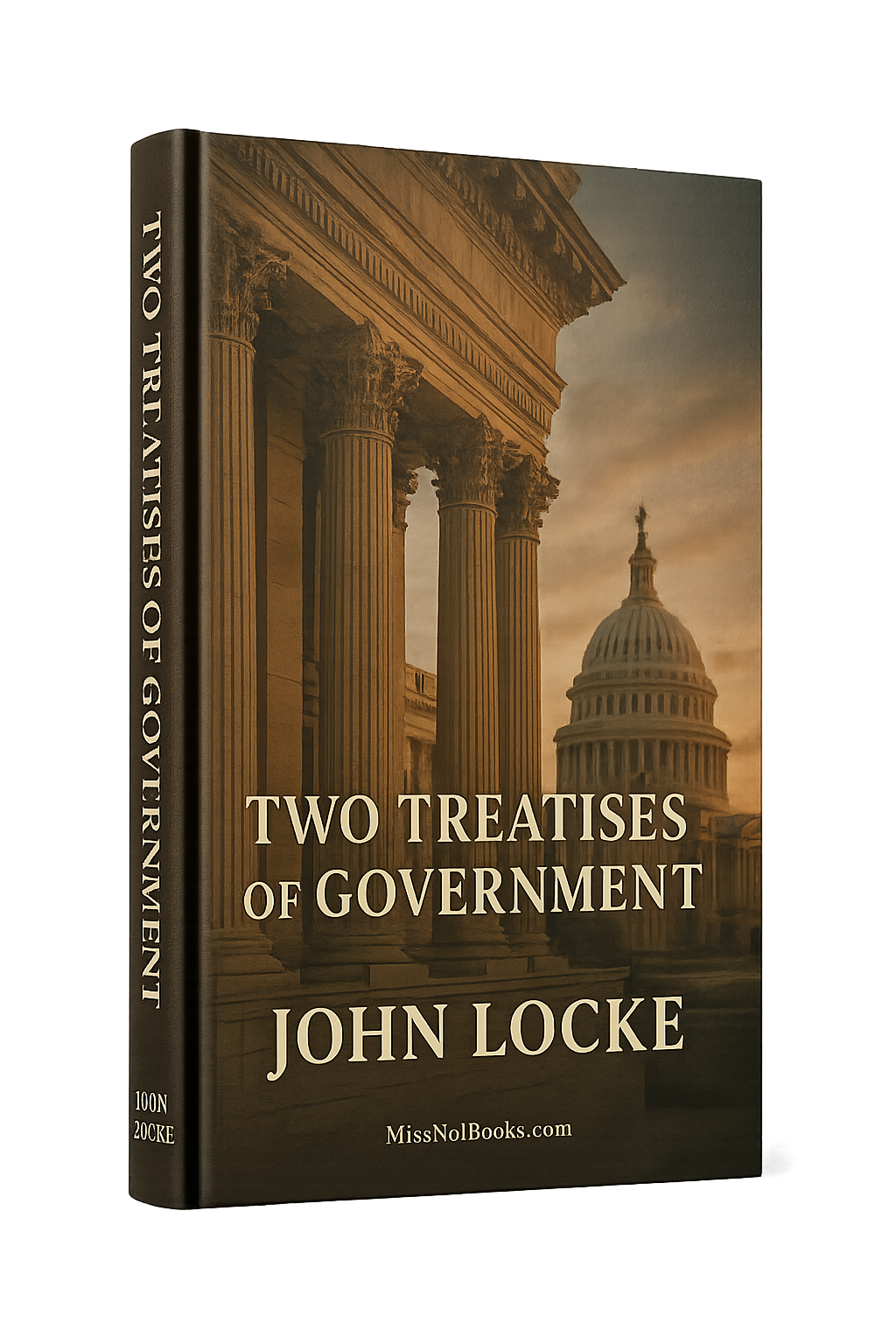
Two Treatises of Government
In the realm of political philosophy, few texts have ignited as profound a transformation as this pivotal work. With the audacity to challenge centuries of absolutist rule and to advocate for the inalienable rights of individuals, this book reshaped our understanding of governance and laid the groundwork for modern democracy. It offered a revolutionary perspective on the nature of power, asserting that legitimate political authority must derive from the consent of the governed. By articulating the principles of liberty, equality, and individual rights, it introduced ideas that not only energized thinkers of its time but also resonated through the ages, informing revolutions and democratic movements worldwide.
Don’t miss the opportunity to engage with one of the most influential works of all time. Buy it today and explore the roots of political theory.
Core Ideas and Main Arguments:
- Natural Rights: The text posits that every individual possesses inherent rights to life, liberty, and property, which governments are obligated to respect.
- Social Contract: It argues that governments are formed through a social contract, wherein individuals consent to submit to authority in exchange for protection of their rights.
- Right to Revolution: The work boldly states that citizens have the right to overthrow any government that fails to uphold its obligations or threatens their rights.
- Individual Liberty: The author emphasizes the importance of personal freedom, advocating for a system where individuals are free to pursue their own interests within the bounds of others’ rights.
Author’s Intentions and Context:
The author sought to articulate a vision of government that could counter the prevailing notions of monarchy and divine right during the 17th century. Emerging from a tumultuous historical context marked by political upheaval and civil war in England, this book aimed to address critical philosophical questions regarding authority and individual rights. It was a time when the Enlightenment was challenging traditional structures, and the author intended to convince both the intellectual elite and the common populace that government should be accountable and founded on reason and mutual agreement rather than force.
Structure of the Book:
The text is divided into two treatises:
- First Treatise: This section critiques the concept of absolute monarchy and refutes the argument of divine right, laying the groundwork for a new political framework.
- Second Treatise: Here, the author details his theory of government, outlining the principles of the social contract, the nature of political power, and the conditions under which a government can justifiably be overthrown. Each chapter builds on the previous arguments, culminating in a robust case for liberal democracy.
Key Takeaways:
- The fundamental rights of individuals are not granted by governments but are inherent and must be protected.
- Political power is only legitimate if it is derived from the consent of the governed.
- The governance model should be based on democratic principles, where individuals can participate and hold leaders accountable.
- There exists a moral imperative for citizens to resist tyranny and fight for their rights.
Why It’s Important to Read:
The ongoing relevance of this work is undeniable, profoundly influencing contemporary discussions on governance, human rights, and the legitimacy of political power. Students of political science, history, philosophy, and law will find its principles foundational to understanding democratic theory and the evolution of modern political systems. As societies continue to grapple with questions of authority and individual rights, this book remains a crucial resource for navigating the complexities of freedom, responsibility, and the role of government in the lives of citizens.
Impactful Quotes and Analysis:
-
“Men being by nature all free, equal, and independent, no one can be put out of this estate and subjected to the political power of another without his own consent.”
This quote encapsulates the essence of Locke’s argument for natural rights and the importance of consent in establishing political authority, highlighting the foundational principle of democracy. -
“The end of law is not to abolish or restrain, but to preserve and enlarge freedom.”
Here, the author articulates a vision of law as a protector of liberty rather than a mechanism of oppression, making a vital case for the just functions of government. -
“Where there is no law, there is no freedom.”
This statement underscores the paradox that true liberty cannot exist without established legal frameworks, emphasizing the necessity of law in maintaining order and protecting rights.
About the Author:
John Locke (1632-1704) was an English philosopher and physician, often regarded as one of the most influential Enlightenment thinkers. His views on government, particularly regarding the nature of human rights and the social contract, laid the intellectual foundation for both liberalism and modern democratic thought. His contributions extend beyond political philosophy to areas like education and religious tolerance, making him a key figure in the advancement of Enlightenment ideals that have shaped contemporary society.
This monumental work is Two Treatises of Government by John Locke, brought to you for educational purposes by MissNotBooks.com.