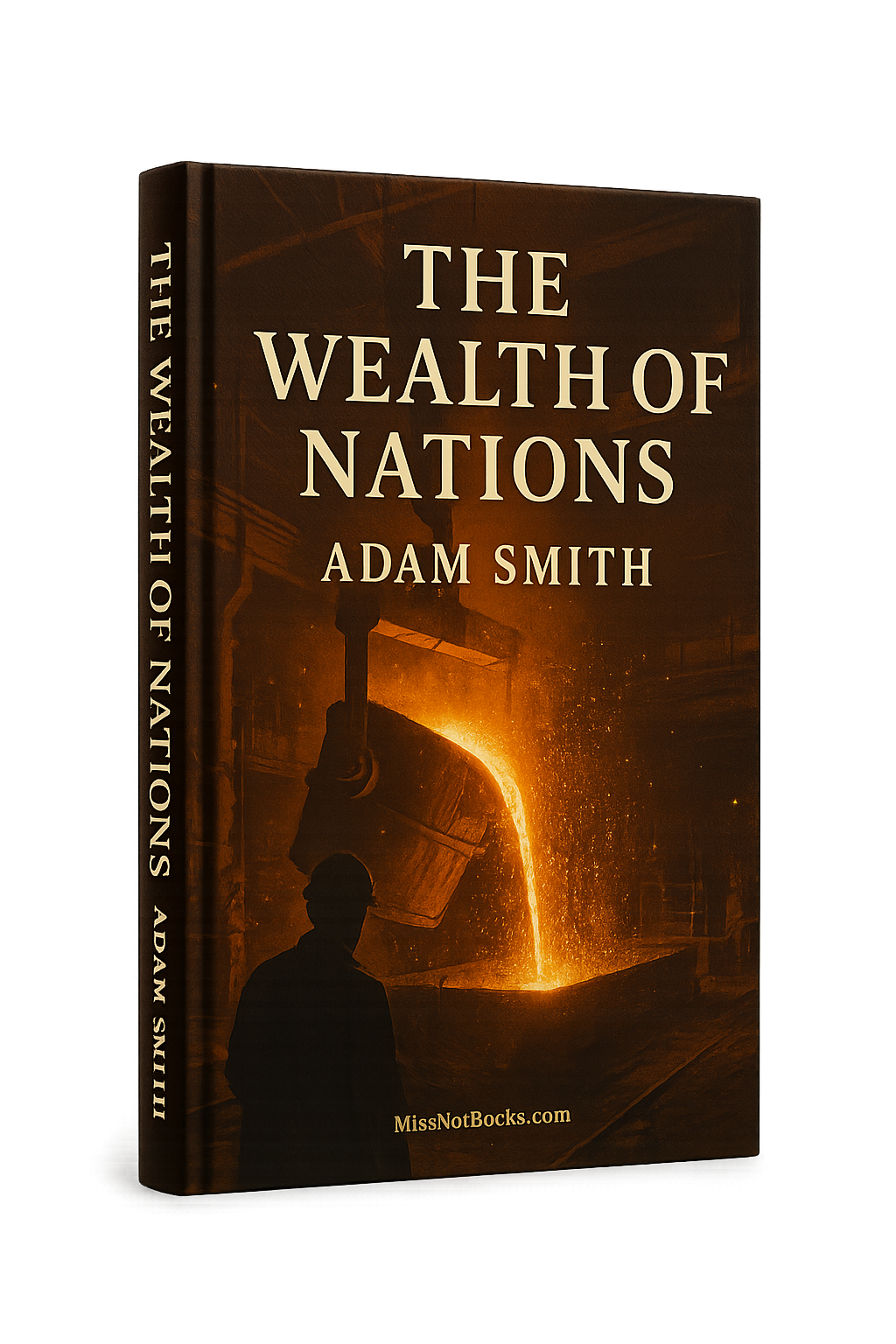
The Wealth of Nations
Throughout history, certain works have catalyzed sweeping transformations in the way we perceive the world and our place within it. This groundbreaking book reshaped economic theory and practice, challenging the prevailing views of its time, while intricately weaving the principles of individual self-interest, morality, and societal welfare. It laid the intellectual groundwork for the discipline of economics, advocating for a system where free markets drive prosperity and innovation. Its profound insights have echoed through centuries, influencing not only economic policies but also the very fabric of modern society.
Core Ideas and Main Arguments:
- Division of Labor: The profound efficiency gains realized through specialization, which enables workers to become adept in their tasks, thereby increasing productivity.
- Invisible Hand: The concept that individuals pursuing their self-interest inadvertently contribute to the overall good of society, as if guided by an unseen force.
- Free Markets: A robust argument for minimal government intervention, positing that unfettered competition leads to better products and innovation.
- Value and Price: An exploration of how prices are determined by supply and demand, and the nuances of labor contributions to value.
- Role of Government: While advocating for a free market, the book outlines essential roles for government, including defense, justice, and public works, that protect the interests of society.
Author’s Intentions and Context: Written at the dawn of the Industrial Revolution, the author sought to illuminate and promote a new economic order that reflected a shifting landscape from agrarian societies to burgeoning urban economies. He responded to an era immersed in mercantilist theories, aiming to challenge the restrictive and often oppressive economic policies of his time. This book's ambitions were not only to understand but to advocate for a system where free enterprise could flourish, grounded in moral philosophy and pragmatism.
Structure of the Book: The book is methodically organized into five main sections:
- Of the Division of Labor: Illustrating how specialization enhances productivity.
- Of the Principle of Exchange: Examining the foundations of trade and value.
- Of Revenue: Discussing land, labor, and capital as sources of wealth.
- Of the Influence of the Government: Addressing the necessary roles of government in economic matters.
- Of the Progress of Opulence: An overall reflection on the growth of commerce and its societal impact.
Each section builds upon the last, presenting a cohesive argument for the principles of free-market economics and the conditions for societal wealth.
Key Takeaways:
- Understanding the mechanics of market economies and the importance of specialization.
- The recognition of the dynamic interplay between self-interest and societal benefit.
- Emphasizing the pivotal role of market forces in resource allocation.
- Insights into the delicate balance of government influence in economic matters.
Why It’s Important to Read: This seminal work is pivotal for anyone aiming to understand the foundations of modern economics and the philosophies that underpin our current financial systems. Students, policymakers, economists, and curious minds alike will find invaluable insights that continue to provoke discussion and inquiry today. Its themes resonate with ongoing debates about capitalism, market regulation, and the role of governments, making it essential reading for those keen on grasping the complexities of economic thought and its real-world applications.
Impactful Quotes and Analysis:
-
"It is not from the benevolence of the butcher, the brewer, or the baker that we expect our dinner, but from their regard to their own interest."
This statement encapsulates the essence of self-interest driving economic prosperity and underscores the intricate nature of societal interdependence. -
"Every human being is motivated to seek his own advantage."
Here, the author deftly argues that self-interest is not merely a trait but a fundamental human driver that shapes economic interactions and societal structures. -
"The great object of the policy of all nations is to augment the wealth of the state."
This quote reflects the central thesis of economic policy as a means to elevate societal wealth—a notion that continues to echo in contemporary political discourse.
About the Author: Adam Smith (1723-1790) was a Scottish philosopher and economist whose ideas laid the groundwork for modern economic theory. As a key figure in the Scottish Enlightenment, Smith's interdisciplinary approach combined moral philosophy with economic thought, paving the way for the field of economics as we know it today. His legacy endures in discussions on market dynamics, capitalism, and the interplay of morality and economics.
Don’t miss the opportunity to engage with one of the most influential works of all time. Buy it today and explore the foundation of modern economics. This monumental work is The Wealth of Nations by Adam Smith, brought to you for educational purposes by MissNotBooks.com.