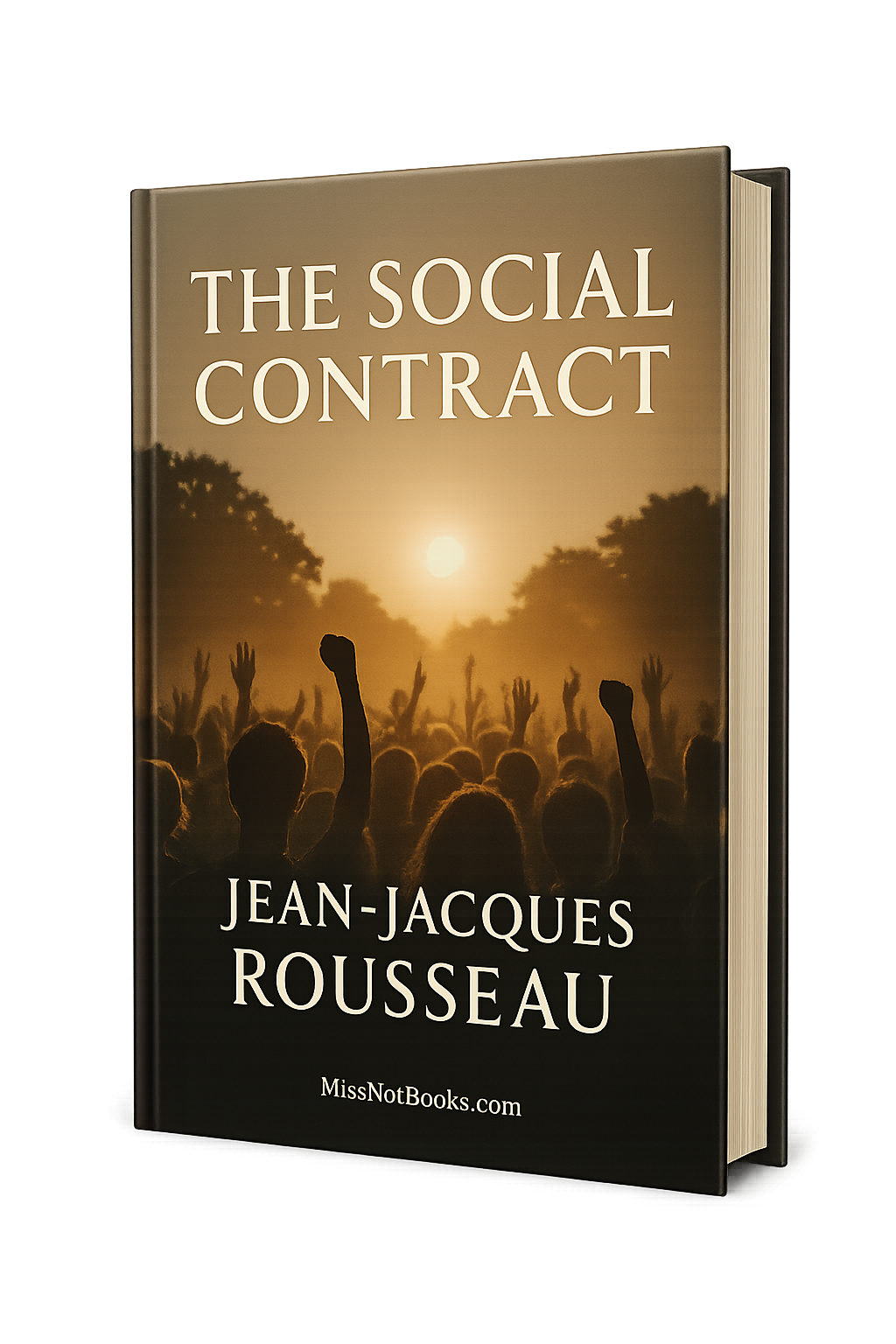
The Social Contract
In a time when traditional governance and social hierarchies were being fiercely questioned, one remarkable text emerged that dramatically transformed our understanding of liberty, equality, and political legitimacy. This book challenged the very foundations of authority and governance, proposing a radical reimagining of the social order that still resonates today. By articulating the principles of democracy and the essential connection between the individual and the collective, it not only laid the groundwork for modern political theory but also inspired revolutions across nations and centuries. Exploring the delicate balance between personal integrity and societal responsibilities, it remains a beacon of revolutionary thought and an invitation to reflect on the essence of human connection within a political framework.
Don’t miss the opportunity to engage with one of the most influential works of all time. Buy it today and explore the roots of political theory and the foundations of democratic thought.
Core Ideas and Main Arguments:
- The concept of the "general will" emphasizes collective decision-making and the importance of the common good over individual interests.
- The critique of inequality examines how social structures can perpetuate oppression, urging society to rethink value systems based on merit and moral worth rather than wealth or birthright.
- The idea of a social contract as an agreement among individuals to form communities, which serves to protect freedom while establishing order.
- The exploration of freedom as both a natural right and a societal obligation, positing that true freedom is found within laws that the people enact themselves.
Author’s Intentions and Context: Jean-Jacques Rousseau wrote within the Enlightenment era, responding to the philosophical and political upheavals of his time. His motivations were rooted in a passionate belief that humanity had strayed from its natural state of freedom and equality due to the corrupting influence of civilization. The book reflects his aspirations to inspire a rethinking of social and political norms, advocating for a system built on participatory governance where the power originates from the people.
Structure of the Book:
- The opening sections introduce the idea of the social contract as a foundational agreement necessary for organized society.
- Following this introduction, Rousseau elaborates on the concept of the general will, detailing the elements required for its realization.
- The latter sections critique existing political structures and propose solutions to foster a just society.
- The concluding chapters contemplate the implications of his ideas for governance and individual freedom, encapsulating the interplay between political authority and personal liberty.
Key Takeaways:
- The importance of the collective good in shaping political authority and law.
- Recognition of social inequality and its implications for governance and social justice.
- Understanding the social contract as the cornerstone of legitimate political power.
- The idea that true freedom is realized within the bounds of laws created by an engaged and participatory populace.
Why It’s Important to Read: This work remains profoundly relevant today as we continue to grapple with issues of governance, justice, and individual rights in an increasingly complex world. Readers from all walks of life—be they students of political science, advocates for social change, or anyone interested in understanding the dynamics of power—will find profound insights and inspiration. The book challenges contemporary readers to reflect critically on their own social contracts and the nature of the obligations they hold toward their communities.
Impactful Quotes and Analysis:
- “Man is born free, and everywhere he is in chains.” This striking assertion emphasizes the tension between natural rights and societal constraints, provoking readers to consider the structures that limit their freedom.
- “The general will is always right, but the will of all is not always the general will.” This quote highlights the distinction between collective decision-making that serves the common interest and mere aggregation of individual desires, urging readers to think critically about the authenticity of democratic expression.
- “Liberty is the ability to choose one’s own path.” This powerful statement encapsulates the essence of Rousseau’s vision for a society where individual agency and collective governance coexist harmoniously.
About the Author: Jean-Jacques Rousseau (1712-1778) was a Swiss-born philosopher, writer, and composer whose ideas deeply influenced the French Revolution as well as the development of modern political, sociological, and educational thought. Known for his groundbreaking works on political philosophy, particularly those concerning individual freedom and social equity, Rousseau’s legacy endures as he remains a pivotal figure in discussions about democracy and human rights.
This monumental work is The Social Contract by Jean-Jacques Rousseau, brought to you for educational purposes by MissNotBooks.com.