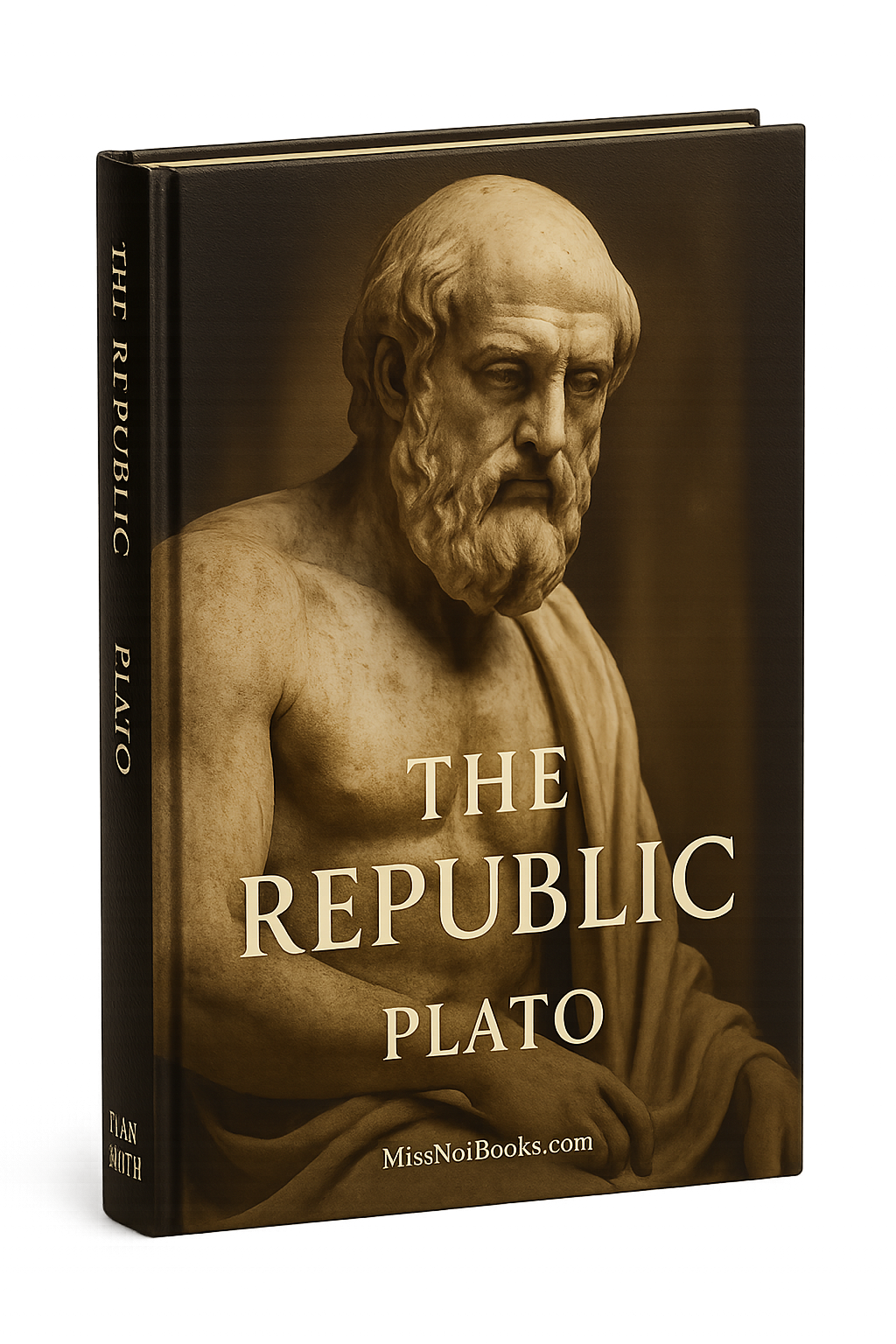
The Republic
In a world where ideas shape societies, few works have been as transformative as a particular philosophical treatise that redefined the nature of justice, governance, and the human condition. Emerging from a tumultuous period marked by political instability and moral questioning, this book has profoundly influenced the foundations of Western thought. Its revolutionary articulation of an ideal state and the examination of individual morality resonate across centuries, challenging readers to contemplate their personal and collective ethics. This enduring dialogue about the essence of truth and virtue urges not just philosophical inquiry but active engagement with the structures that govern our lives. Don’t miss the opportunity to engage with one of the most influential works of all time. Buy it today and explore the roots of political theory.
Core Ideas and Main Arguments:
- The concept of justice is central, emphasizing that a just society reflects individual moral integrity.
- The theory of the tripartite soul, delineating reason, spirit, and appetite, is crucial for understanding human motivation and ethics.
- The allegory of the cave serves as a powerful metaphor for enlightenment, illustrating the journey from ignorance to knowledge.
- The ideal state is entwined with the philosopher-king concept, suggesting that knowledge and wisdom are essential for effective governance.
- The work critiques democracy and other forms of government, analyzing their limitations and potential for corruption.
Author’s Intentions and Context: The author sought to explore a vision of a just society during a period of political chaos in ancient Greece, particularly following the Peloponnesian War. By proposing a structured approach to governance and morality, he intended to address the philosophical dilemmas of his time, such as the nature of justice and the role of the individual in society. This exploration was an endeavor to guide humanity toward an idealized form of governance that emphasized rationality and virtue over chaotic populism.
Structure of the Book: The text is organized into ten books, each progressively building on the previous discussions:
- Books I & II: Introduce the concept of justice and debate its definition.
- Books III & IV: Discuss the education and virtues of guardians in the ideal state.
- Books V to VII: Explore complex ideas like the role of women in society, the nature of the philosopher-king, and the allegory of the cave.
- Books VIII & IX: Analyze different forms of government and the decline of the ideal state.
- Book X: Concludes with a discussion on the immortality of the soul and the potential consequences of an immoral life.
Key Takeaways:
- Justice is intrinsically connected to the well-being of individuals and society.
- Effective governance requires that leaders be guided by knowledge and wisdom.
- Enlightenment is a difficult process, often resisted by those comfortable in ignorance.
- The pursuit of truth and philosophical dialogue is essential to human fulfillment.
Why It’s Important to Read: Engaging with this work encourages critical thinking about fundamental questions of ethics and governance that persist in today's political landscapes. It offers invaluable insights into the nature of human behavior, societal organization, and the balance between individual rights and collective responsibility. Students of philosophy, political science, and history will particularly benefit, gaining tools to analyze contemporary issues through a philosophical lens.
Impactful Quotes and Analysis:
-
"The heaviest penalty for declining to rule is to be ruled by someone inferior to yourself."
This statement underscores the responsibility of the educated elite to engage in governance, warning against complacency. -
"The unexamined life is not worth living."
This profound assertion reaffirms the intrinsic value of self-reflection and philosophical inquiry, advocating for a life of purpose and thought. -
"Justice means minding your own business and not meddling with other men's concerns."
This definition emphasizes the importance of individual roles within society, fostering harmony and productivity.
About the Author: Plato, born around 428/427 BC and passing around 348/347 BC, was an ancient Greek philosopher and a student of Socrates. Founder of the Academy in Athens, one of the earliest institutions of higher learning in the Western world, he profoundly influenced subsequent philosophical thought, particularly in ethics, politics, and metaphysics. His explorations of ideal forms and governance laid the groundwork for much of Western philosophy that followed.
This monumental work is The Republic by Plato, brought to you for educational purposes by MissNotBooks.com.