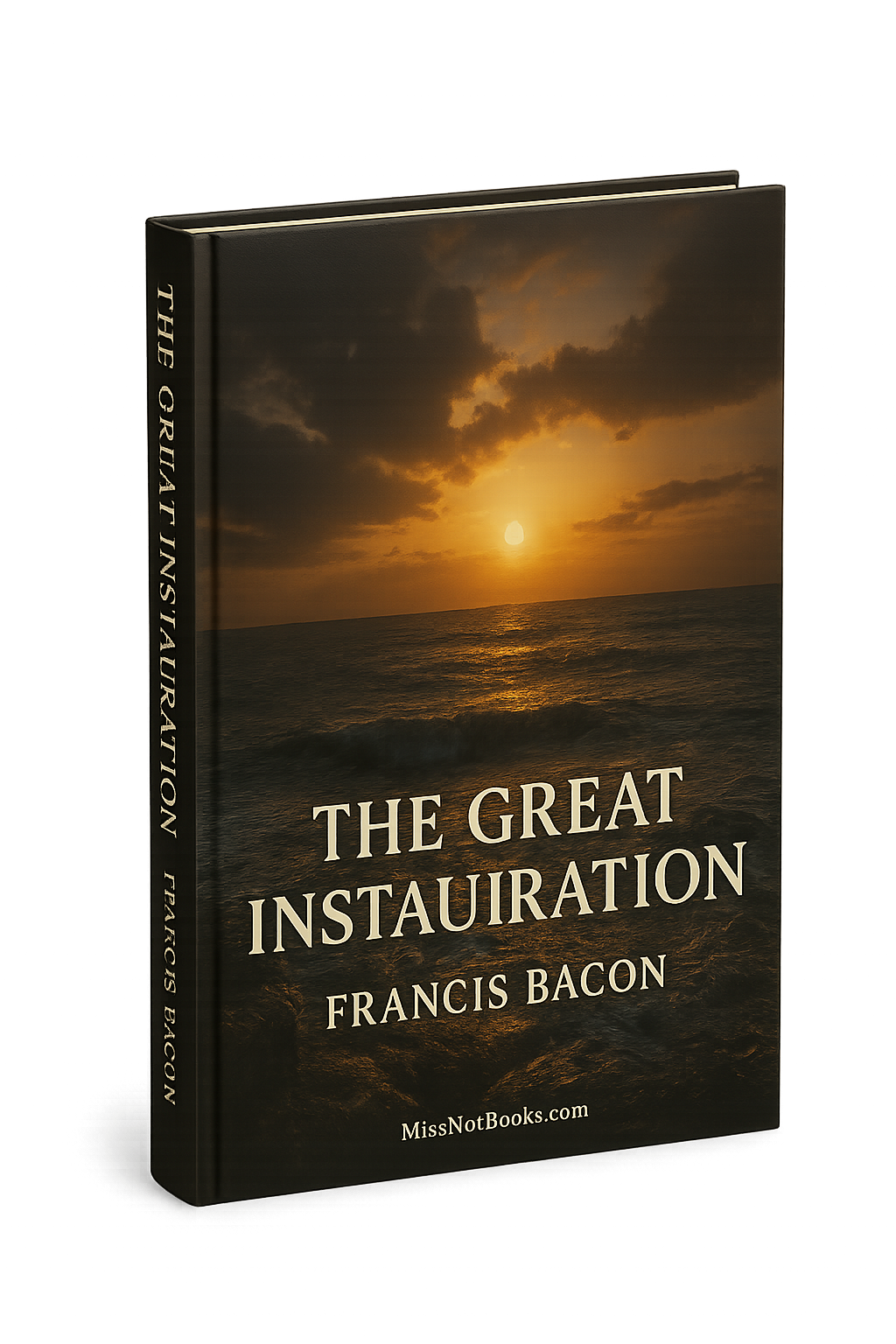
The Great Instauration
In an era marked by reliance on ancient authority, one seminal work emerged that fundamentally altered the landscape of human knowledge and inquiry. This book challenged the prevailing methodologies of its time, advocating for a systematic, empirical approach to understanding the natural world. It laid the cornerstone for modern scientific methods, and its revolutionary ideas continue to influence how we conceive of knowledge, progress, and the role of human beings in the pursuit of truth. A transformative beacon of enlightenment, this work invites readers into a new paradigm that reshapes our engagement with the world around us.
Core Ideas and Main Arguments
- Empiricism Over Authority: The text posits that knowledge should be derived from observation and experimentation rather than from ancient texts or dogmas.
- Inductive Reasoning: The author argues for a method of reasoning that builds generalizations from specific instances, laying foundational principles for modern scientific research.
- Reconstruction of Knowledge: It calls for a comprehensive overhaul of the intellectual framework of the time, positing that the path to understanding nature requires a new approach.
- Integration of Science and Philosophy: The work bridges the gap between theoretical constructs and practical applications, asserting that knowledge should serve human needs and betterment.
- Collective Human Progress: By advocating for a collaborative pursuit of knowledge, the author emphasizes the importance of systemic inquiry as a means to advance society.
Author’s Intentions and Context The author set forth with the ambition to revive the intellectual spirit of inquiry during a time when Europe was entrenched in medieval scholasticism and Aristotelian dogma. Responding to the challenges posed by the Scientific Revolution, he envisioned a new philosophy that would not only dismantle outdated paradigms but also inspire a new generation of thinkers and scientists. His critical approach to knowledge aimed to empower humanity by emphasizing the importance of empirical investigation and the continuous search for truth.
Structure of the Book The work is methodically organized into sections that reflect a progressive unfolding of ideas:
- Introduction to New Philosophy: An overview of his vision for transforming knowledge practices.
- The Nature of Knowledge: Exploring the limitations of conventional scholarship.
- Proposed Methodologies: Detailed exposition of inductive reasoning and empirical methods.
- Implications for Society: A discussion on how this new knowledge can be harnessed for societal improvement.
- Future of Human Discovery: Speculations on the continued evolution of knowledge and its benefits.
Key Takeaways
- The essential rejection of dogma opens pathways for innovation and discovery.
- Embracing empirical methods enhances the reliability and validity of knowledge.
- The call to action for collective intellectual endeavors strengthens the quest for truth.
- A renewed understanding of humanity’s role in knowledge creation redefines our relationship with the universe.
Why It’s Important to Read This book remains pertinent in the contemporary discourse on science, philosophy, and ethics, urging readers to reflect on the importance of questioning established norms and embracing a methodical pursuit of understanding. Scholars, scientists, and those interested in the development of modern thought will find it indispensable, as its principles underlie much of today’s scientific inquiry and intellectual pursuits.
Impactful Quotes and Analysis
-
“Knowledge is power.” — This succinct declaration encapsulates the essence of empowerment through learning and the transformative nature of knowledge.
-
“Nature, to be commanded, must be obeyed.” — A powerful reminder that true mastery over the natural world comes from a humble understanding and respect for its laws.
-
“Human knowledge and human power meet in one; for where the cause is not known, the effect cannot be produced.” — This profound insight speaks to the essence of scientific reasoning and the cyclical relationship between knowledge and capability.
About the Author Francis Bacon (1561–1626) was an English philosopher and statesman whose ideas laid the groundwork for the modern scientific method. Known as the father of empiricism, his work bridged the gap between philosophy and science, advocating for a systematic approach to knowledge that remains influential today. His legacy continues to shape the dialogue around human inquiry, ethics in science, and the pursuit of understanding.
Don’t miss the opportunity to engage with one of the most influential works of all time. Buy it today and explore the foundations of modern logic and scientific inquiry. This monumental work is The Great Instauration by Francis Bacon, brought to you for educational purposes by MissNotBooks.com.