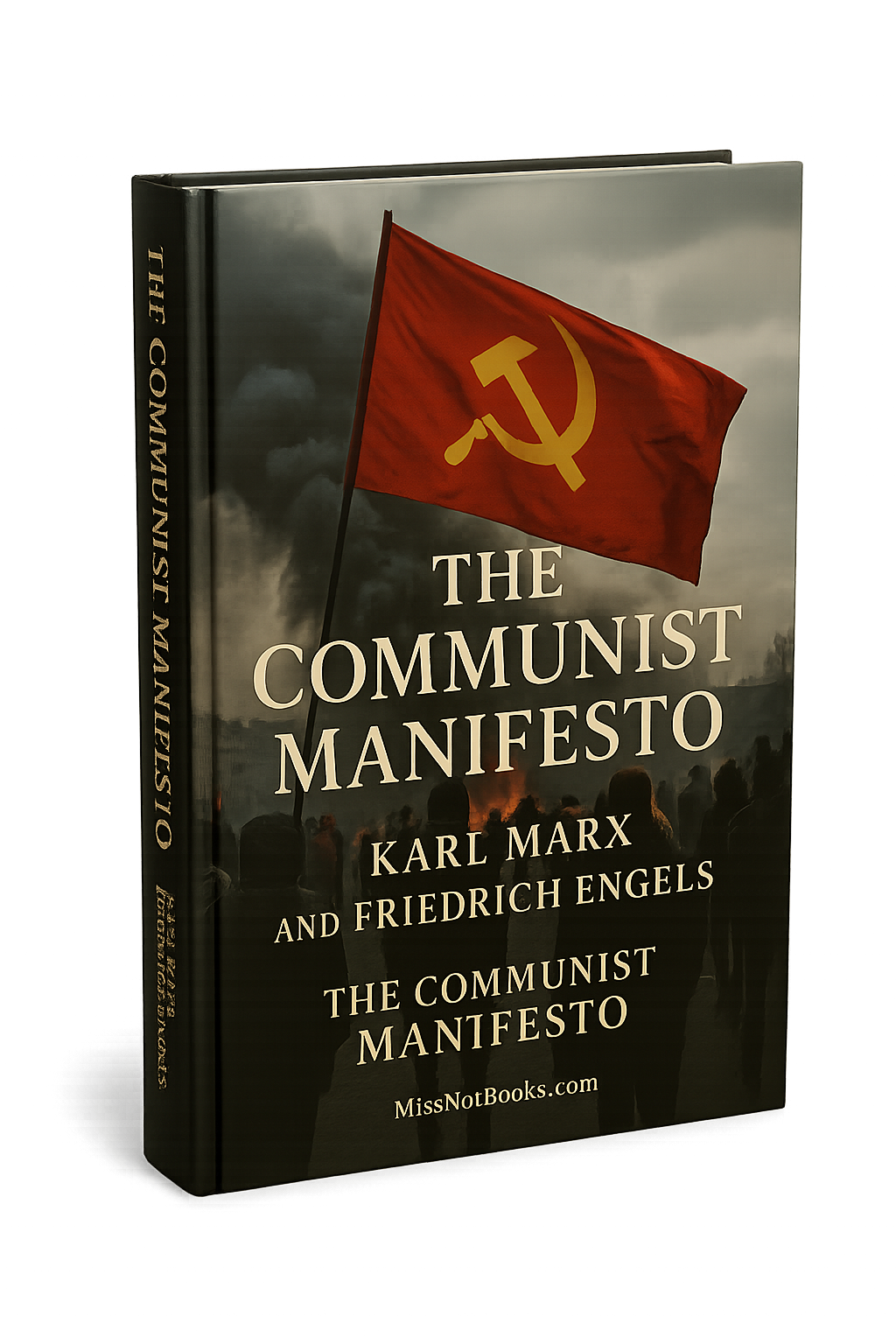
The Communist Manifesto
In a world inevitably shaped by class struggle and systemic inequalities, one groundbreaking text emerged from the tumult of the 19th century that would forever alter the landscape of political thought and social activism. This work not only introduced a radical critique of capitalism but also galvanized the working class and ignited revolutions across continents. It boldly challenged the status quo, advocating for the rights and empowerment of the proletariat like never before. With its incisive clarity and urgency, this book serves as a rallying cry for those yearning for social justice and equality, leaving an indelible mark on history that resonates strongly in contemporary discussions on economic disparity and class relations.
Core Ideas and Main Arguments
- Class Struggle as History’s Motor: The text posits that all historical progress is rooted in the conflicts between social classes, primarily between the bourgeoisie (capitalists) and the proletariat (working class).
- Critique of Capitalism: It elucidates the ways in which capitalism exploits labor, creating wealth for a few while impoverishing the masses.
- Call for Revolution: The authors argue that the proletariat must rise up to overthrow the capitalist system, replacing it with a classless society where the means of production are communally owned.
- Global Solidarity: The manifesto emphasizes the need for international cooperation among workers, encapsulated in the famous rallying cry, "Workers of the world, unite!"
Author’s Intentions and Context Written in the context of a rapidly industrializing Europe marked by social upheaval, this manifesto sought to articulate the frustrations of the working class and present a coherent framework for revolutionary change. Marx and Engels aimed to provide not only a description of the socio-economic injustices of their time but also a practical guide for action. Their intent was to empower the disenfranchised, giving them a foundation from which to seek equality and justice against the oppressive forces of capitalism and imperialism.
Structure of the Book The text is divided into four sections:
- Bourgeois and Proletarians: Introduces the fundamental conflict of interests between the capitalist class and the working class.
- Proletarians and Communists: Clarifies the role of communists in the proletariat movement and outlines the principles of communist theory.
- Socialist Literature: Critiques other socialist movements at the time, positioning their ideas against the authors' revolutionary vision.
- Communism: Concludes with a declaration of the aims of communism and a call to action for global unity among workers.
Each section builds upon the last, progressively unfolding the authors' revolutionary vision while articulating the urgency of their work.
Key Takeaways
- Social and economic inequalities are rooted in historical class struggles.
- Capitalism is fundamentally exploitative, leading to systemic oppression of the working class.
- Real change requires collective action and unity among the oppressed.
- The vision of a classless society is not only possible but necessary for human flourishing.
Why It’s Important to Read The enduring relevance of this text cannot be overstated. Its insights into class dynamics and systemic inequalities are as poignant today as they were in the 19th century, making it essential reading for anyone interested in social justice, economic theory, or political activism. Students of history, sociology, and economics will find profound value in its critiques and ideas, while activists can draw inspiration and strategies for contemporary movements for change.
Impactful Quotes and Analysis
-
"The history of all hitherto existing society is the history of class struggles."
This opening declaration sets the tone for the manifesto, framing history not as a narrative of progress but as a battleground of competing interests—a thought that remains crucial in understanding social dynamics today. -
"Workers of the world, unite; you have nothing to lose but your chains!"
This rallying cry encapsulates the essence of solidarity and empowerment, transcending time and inspiring collective action against oppression. -
"The proletarians have nothing to lose but their chains. They have a world to win."
This quote emphasizes the potential for transformative change among the oppressed, instilling hope and a sense of agency that continues to resonate with social movements.
About the Author Karl Marx (1818-1883) was a German philosopher, economist, and revolutionary socialist whose ideas laid the foundation for much of modern socialist thought. Alongside Friedrich Engels (1820-1895), Marx co-authored several influential texts that critiqued capitalism and advocated for revolutionary change, leaving a profound legacy that continues to influence political ideologies and movements worldwide.
This monumental work is The Communist Manifesto by Karl Marx and Friedrich Engels, brought to you for educational purposes by MissNotBooks.com.