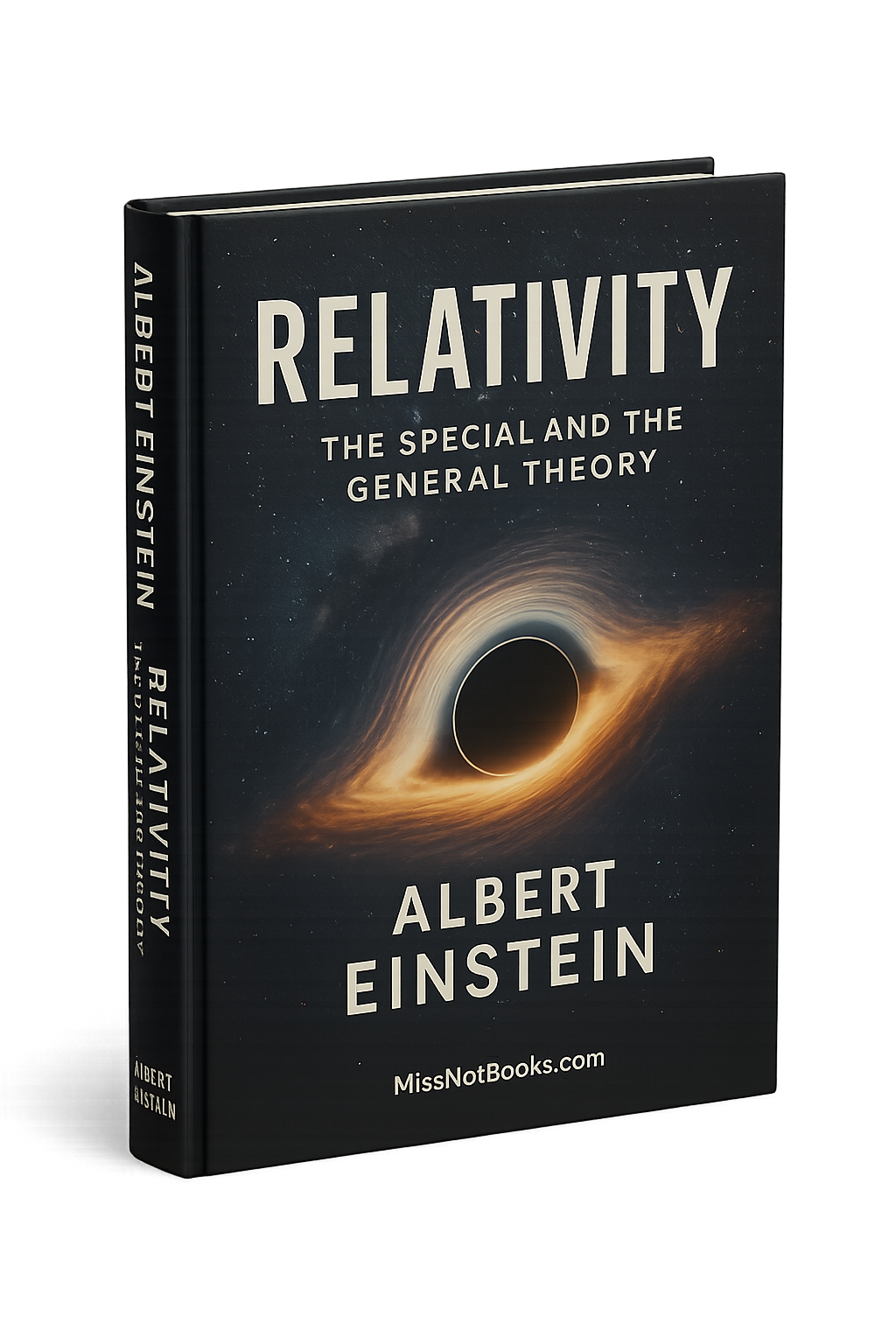
Relativity: The Special and the General Theory
In a world forever altered by the marvels of modern physics, one book stands as a beacon of transformative thought, revolutionizing our understanding of time, space, and the fundamental workings of the universe. This groundbreaking text challenged the very fabric of classical mechanics, opening the door to a realm where the powerful interplay of speed and gravity could no longer be viewed through the lens of traditional paradigms. Its influence extends beyond the confines of science; it has infiltrated the cultural and philosophical milieu, shifting how we perceive reality itself. Engaging with this work promises to enrich your perspective and deepen your understanding of the cosmos—don’t miss the opportunity to engage with one of the most influential works of all time. Buy it today and explore the roots of modern physics.
Core Ideas and Main Arguments
- The Nature of Space and Time: The book introduces the radical idea that space and time are not absolutes but interwoven concepts that can be distorted by speed and gravity.
- Relativity of Simultaneity: It posits that events perceived as simultaneous can vary depending on the observer's frame of reference, undermining the certainty of Newtonian physics.
- Equivalence of Mass and Energy: This pioneering work elucidates the revolutionary equation ( E=mc^2 ), establishing the profound relationship between mass and energy—a cornerstone of modern physics.
- Curvature of Space: The text proposes that massive objects like planets and stars warp the fabric of space-time, offering a new way to understand gravitational forces.
Author’s Intentions and Context
The author set out to formulate a theory that would reconcile the inconsistencies found in Newtonian physics, particularly as they applied to high-speed phenomena and gravitational influences. Written during the early 20th century, a period marked by rapid scientific advancements and burgeoning technological innovations, the text represents a response to the limitations observed in classical physics and offers an intellectual framework for understanding the universe in an entirely new way. This bold endeavor aimed to push the boundaries of human knowledge, seeking not merely to explain the universe but to redefine humanity’s place within it.
Structure of the Book
The book is structured in a clear and methodical format, beginning with an accessible introduction to the key concepts of special relativity, followed by a detailed exposition of general relativity. The first part focuses on the implications of light speed and inertial frames, while the second delves into the complexities of gravitation and curvature of space-time. Each chapter builds upon the last, guiding the reader through complex ideas with clarity and precision.
Key Takeaways
- Revolutionized View of Physics: A robust understanding of how space and time operate differently than previously thought.
- Foundation for Modern Physics: Establishes principles that underpin contemporary fields such as astrophysics and quantum mechanics.
- Critical Thinking: Encourages a questioning attitude toward established norms and the importance of revising theories in light of new evidence.
Why It’s Important to Read
This monumental work is essential reading for anyone interested in the fundamental principles that govern our universe. Its ideas continue to resonate across scientific disciplines, influencing not only physicists but also philosophers, mathematicians, and even artists who grapple with the implications of relativistic thought. By engaging with this text, readers will not only enhance their understanding of physics but also gain insight into the nature of reality and existence itself.
Impactful Quotes and Analysis
-
"The only reason for time is so that everything doesn't happen at once."
- This quote captures the essence of our experience of time as a structured progression, highlighting the radical notion that time is not a constant.
-
"God does not play dice with the universe."
- Here, the author expresses a fundamental belief in order within the cosmos, challenging the randomness that quantum mechanics appeared to introduce.
-
"All our science, measured against reality, is primitive and childlike—and yet it is the most precious thing we have."
- This poignant reflection emphasizes the humble yet invaluable pursuit of scientific understanding, acknowledging the limits of human knowledge while celebrating its significance.
About the Author
Albert Einstein (1879-1955) was a theoretical physicist whose contributions reshaped our understanding of the physical world. Best known for his theories of special and general relativity, he gained global prominence for his work on the photoelectric effect, earning the Nobel Prize in Physics in 1921. Einstein's ideas transcended the scientific community, making him a cultural icon and a symbol of intellectual inquiry in the 20th century. His legacy endures, firmly establishing him as one of the most influential figures in the history of science.
This monumental work is Relativity: The Special and the General Theory by Albert Einstein, brought to you for educational purposes by MissNotBooks.com.