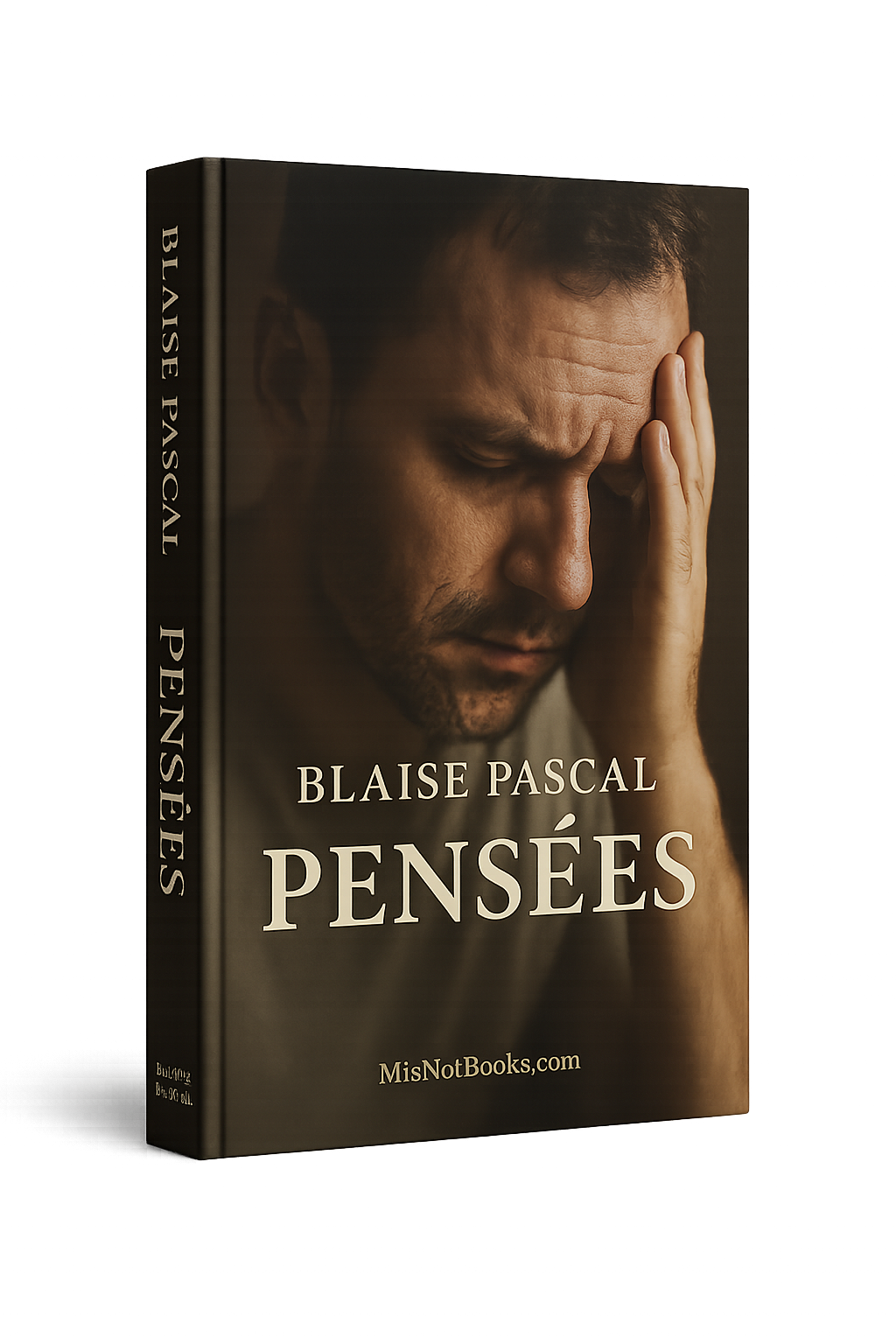
Pensées
In an age marked by intellectual upheaval and existential inquiry, a singular work emerged that has since transformed the landscape of philosophical and scientific thought. This book revolutionized how humanity grapples with the dichotomy of faith and reason, offering profound insights into the human condition and the complexities of belief. By challenging the prevailing rationalist paradigm and addressing the deep-seated fears and hopes that define our existence, it presented a framework for understanding the intricate interplay between the divine and the human spirit. Its exploration of the limitations of reason and the necessity of faith resonates through the ages, inviting generations to reconsider their perspective on life’s ultimate questions.
Core Ideas and Main Arguments:
- The duality of human existence, caught between the infinite and the finite, urging readers to confront the depths of both despair and hope.
- A critique of pure rationalism, emphasizing that human understanding has its limits and that there are realms only accessible through faith.
- The ‘leaps of faith,’ where belief is posited as a necessary response to human uncertainty, proposing that faith is not simply a rejection of reason but a complement to it.
- The concept of the 'wager,' where Pascal argues that believing in God is a prudent choice, given the stakes involved in matters of eternity.
Author’s Intentions and Context: Blaise Pascal, writing during the 17th century, navigated a period of enlightenment and skepticism, characterized by a burgeoning scientific discourse propelled by figures such as Descartes and Newton. He sought to articulate a vision that reconciled the emerging scientific rationality with the metaphysical inquiries of the human soul. In a world rapidly moving towards secularism, Pascal aimed to assert the importance of spirituality without falling into dogma, positing that true knowledge involves an acknowledgment of mystery, faith, and the heart’s role in understanding truth. His work served as both a critique of contemporary philosophical thought and a personal exploration of his own faith struggles.
Structure of the Book: The book is a beautifully structured compilation that intertwines reflections, aphorisms, and treatises. It is typically organized into the following thematic sections:
- Existential Reflections: Introducing the paradoxes of human existence and the nature of the human condition.
- The Limitations of Reason: Diving into the confines of human rationality and its implications for belief and knowledge.
- Faith and Belief: Offering persuasive arguments for the necessity of faith and exploring the implications of the ‘wager.’
- Practical Spirituality: Concluding with reflections on the practical outworking of faith in daily life and the pursuit of true happiness.
Each section builds on the last, creating a tapestry of thought that guides the reader through Pascal’s nuanced understanding of faith, logic, and existential risk.
Key Takeaways:
- The recognition that human logic has inherent limits, and truth often lies beyond rational understanding.
- An enduring argument for faith as a rational choice in the face of uncertainty.
- An exploration of the profound connection between human emotion, reason, and spirituality.
Why It’s Important to Read: This book remains a vital text for anyone interested in the intersections of philosophy, science, and religion. Its insights are not only pivotal for understanding the evolution of thought but also provide comforting and challenging perspectives on modern dilemmas. Scholars, theologians, and anyone grappling with the meaning of life and existence will find value in Pascal’s reflections, which remain strikingly relevant in our contemporary world.
Impactful Quotes and Analysis:
- "The heart has its reasons of which reason knows nothing." This powerful statement encapsulates the interplay between emotion and logic, insisting that human experiences often transcend mere intellectual reasoning.
- "What is man that he is so important?" This question reflects Pascal’s deep concern with human significance in the vast universe, provoking introspection about our place in the cosmos and the value of our existence.
- "We are generally the better for our fears." Here, Pascal suggests that recognizing our fears can lead to deeper understanding and growth, encouraging readers to confront their vulnerabilities rather than shy away from them.
About the Author: Blaise Pascal (1623–1662) was a French mathematician, physicist, inventor, writer, and philosopher. His early work in mathematics laid foundational principles in probability theory and fluid mechanics. However, it is his philosophical writings that have left an indelible mark on Western thought, offering profound insights into the nature of humanity, reason, and faith. Pascal's legacy endures as he continues to challenge readers to explore deeper truths beyond the surface of rationality.
This monumental work is Pensées by Blaise Pascal, brought to you for educational purposes by MissNotBooks.com.