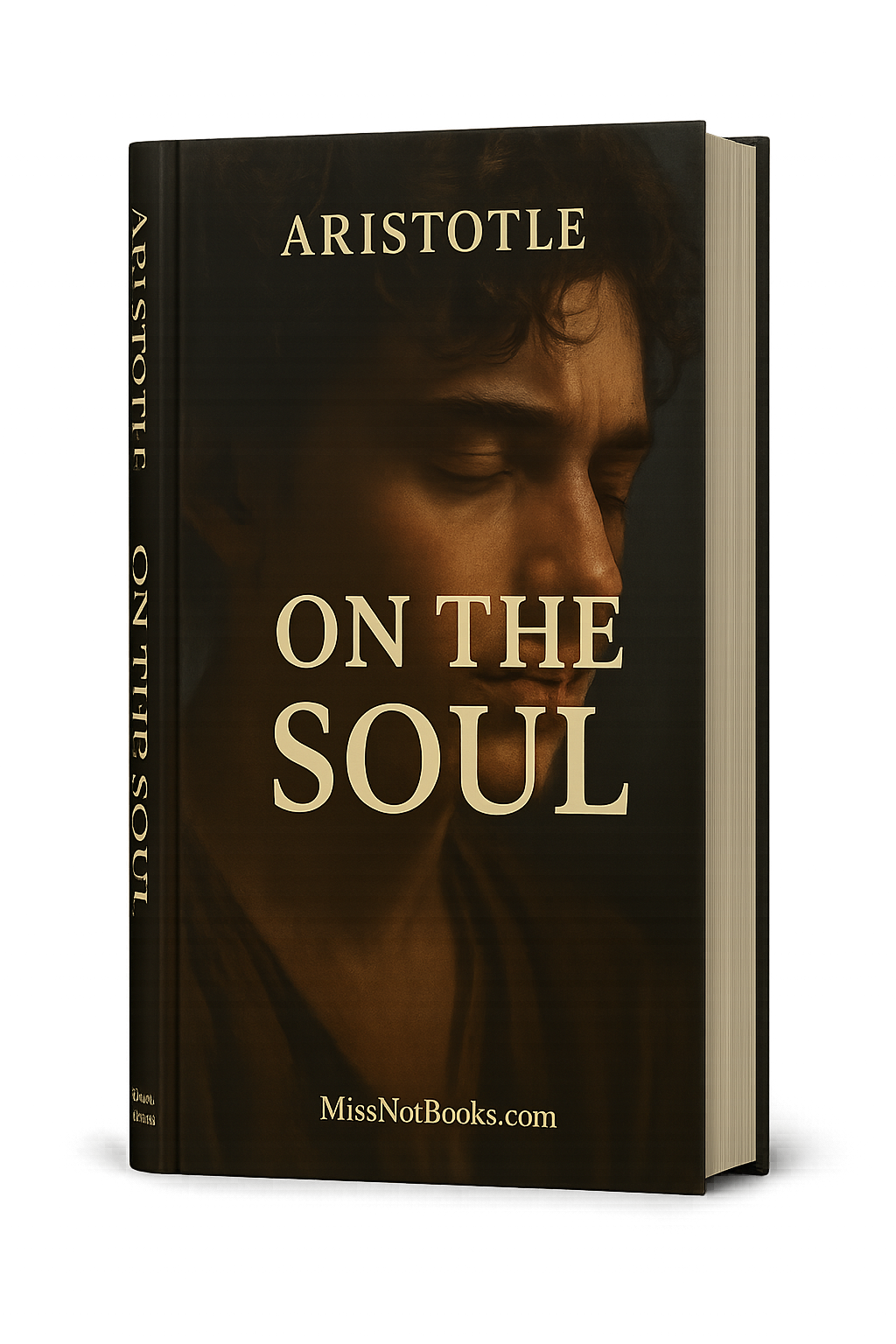
On the Soul
In a landscape where philosophy and science intertwine, few works have cast as long a shadow as this seminal text, which fundamentally transformed our understanding of life and consciousness. With its sharp inquiry into the essence of existence and a novel exposition of the nature of the soul, this book challenged established thought and provided a framework that would govern intellectual discourse for centuries. It introduced concepts that not only revolutionized the study of biology and psychology but also paved the way for later metaphysical and ethical explorations. Its profound implications continue to resonate, demanding engagement from contemporary scholars and thinkers alike.
Core Ideas and Main Arguments
- Nature of the Soul: The text posits that the soul is the form of living beings, central to the realization of their functionalities and purpose.
- Unity of Body and Soul: It emphasizes the inseparable relationship between body and soul, arguing against dualistic separations often drawn by earlier philosophers.
- Hierarchy of Life: The author details a hierarchy of souls, asserting that different organisms possess different types of souls — vegetative, sensitive, and rational.
- Perception and Knowledge: It explores how sensory experiences facilitate knowledge, redefining the roles of rational thought and empirical observation.
- Purpose and Potentiality: The book articulates the concepts of potentiality and actuality, framing them as crucial for understanding growth and change in living beings.
Author’s Intentions and Context Written during a time when the natural world was often explained through myth and superstition, the author sought to provide a systematic investigation into the nature of life itself. In the philosophical milieu of ancient Greece, dominated by figures like Plato, the text aimed to provide a pragmatic counterpoint that emphasized observation and rational inquiry over abstract idealism. The author grappled with the challenges posed by earlier philosophical traditions, seeking to synthesize and expand upon their ideas to forge a more cohesive understanding of human existence and its place in the cosmos.
Structure of the Book The work is methodically organized into several core sections:
- Introduction to the Soul: Defining the soul and its critical role in living organisms.
- Types of Souls: Delineating the different classes of souls and their respective functions.
- Interaction of Body and Soul: Exploring how the soul animates the body and the implications of this relationship.
- Epistemology: Investigating the nature of perception and knowledge acquisition.
- Conclusion on Teleology: Discussing the purpose-driven nature of life and the inherent potentialities within beings.
Each section builds progressively, weaving together a coherent argument that underscores the profound interconnectedness of life forms and their inherent purposes.
Key Takeaways
- The soul is central to understanding life, serving as its animating principle.
- There exists a hierarchy in the forms of life, each with distinct capacities and functions.
- Knowledge and understanding derive from sensory experiences, which in turn inform rational thought.
- The relationship between body and soul is essential to grasp the complexities of living beings.
Why It’s Important to Read This text remains a cornerstone of not only philosophical discourse but also scientific inquiry, bridging the gap between empirical observation and theoretical reflection. Readers from varied disciplines—philosophers, biologists, psychologists, and historians—will find value in its enduring questions about existence and consciousness. Its insights facilitate a deeper understanding of humanity’s ongoing quest to comprehend itself and the world it inhabits.
Impactful Quotes and Analysis
-
"The soul never thinks without a picture."
This quote emphasizes the integral relationship between sensory experience and cognitive processes, suggesting that our understanding of reality is deeply rooted in perception. -
"The whole is greater than the sum of its parts."
This classic formulation reflects the author’s insight into the emergent properties of organized systems, stressing the importance of holistic perspectives in both natural and social sciences. -
"To be is to be perceived."
This statement encapsulates the epistemological shift towards understanding existence as intrinsically linked to observation, a principle that reverberates through modern philosophy and science.
About the Author The author of this influential work, Aristotle (384–322 BC), was a towering figure in ancient Greek philosophy whose ideas laid the groundwork for much of Western thought. A student of Plato and tutor to Alexander the Great, Aristotle contributed extensively across various fields, including ethics, metaphysics, politics, and natural sciences. His legacy endures through a vast corpus of work that continues to inform and inspire diverse intellectual traditions, underpinning countless modern disciplines.
Don’t miss the opportunity to engage with one of the most influential works of all time. Buy it today and explore the foundation of modern thought about consciousness and existence. This monumental work is On the Soul by Aristotle, brought to you for educational purposes by MissNotBooks.com.