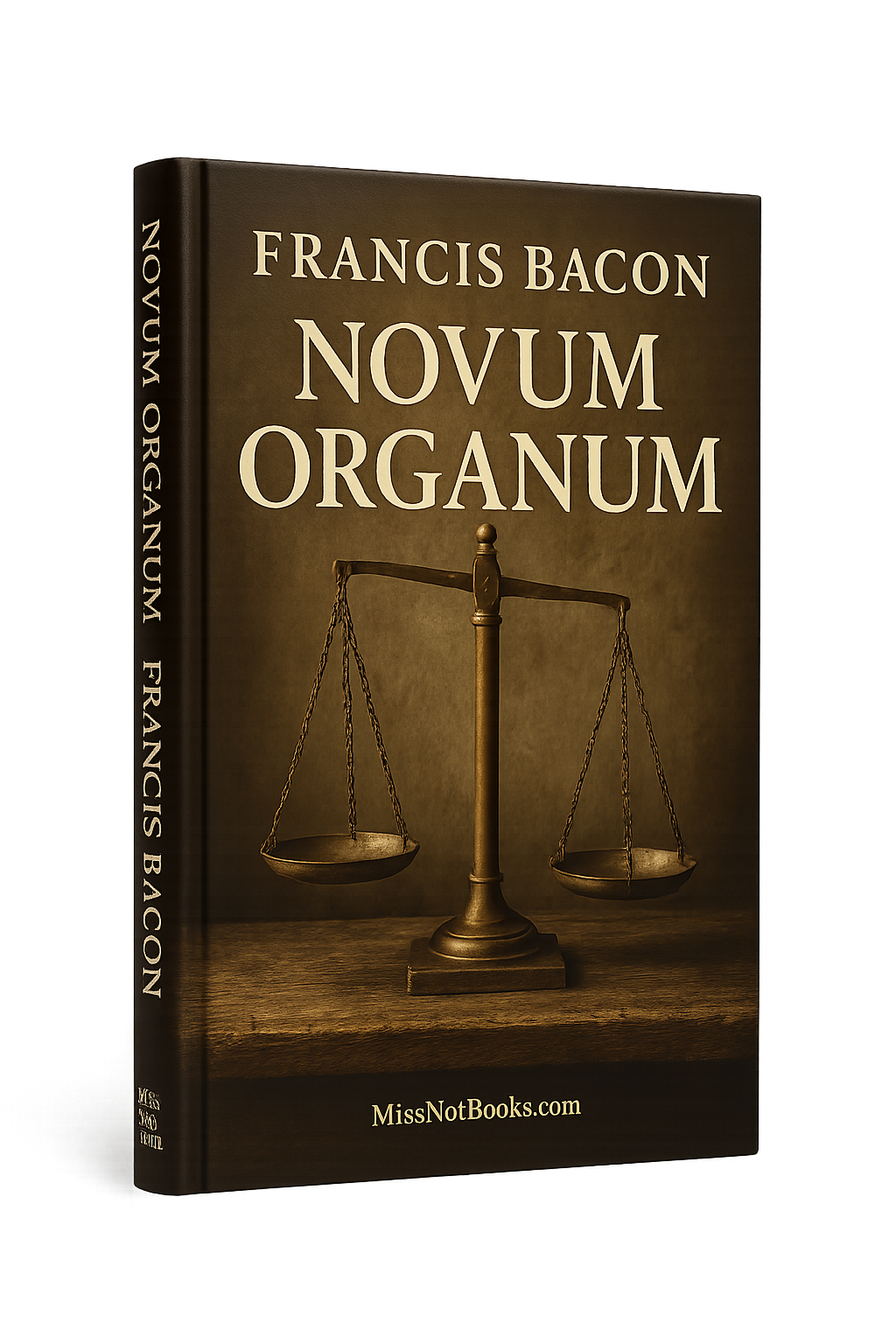
Novum Organum
In a world that was rapidly evolving through exploration, experimentation, and burgeoning scientific thought, one remarkable work emerged to redefine the way humanity approached knowledge and inquiry. This transformative text played a pivotal role in the evolution of scientific methodology, empowering thinkers to break free from the constraints of dogma and uncritical acceptance of tradition. It championed a new vision of knowledge as an active pursuit, advocating for systematic observation and empirical investigation. By heralding the importance of inductive reasoning, it set the stage for modern science, challenging the established frameworks that had dominated intellectual discourse for centuries and fundamentally changing how we understand and interact with the natural world. Don’t miss the opportunity to engage with one of the most influential works of all time. Buy it today and explore the foundation of modern scientific inquiry.
Core Ideas and Main Arguments:
- Empiricism over Dogma: The book emphasizes the necessity of observation and experimentation as foundational to understanding nature, opposing reliance on antiquated philosophies.
- Inductive Reasoning: It articulates the significance of inductive reasoning, advocating for building general principles from specific observations, revolutionizing how knowledge is formed.
- The Four Idols: The author introduces the concept of the "Four Idols" (of the Tribe, the Cave, the Marketplace, and the Theatre) as obstacles to true understanding, encouraging self-reflection and critical thinking.
- Knowledge as Power: A central tenet of the text is that the acquisition and application of knowledge confers power, urging mankind to harness knowledge to improve their circumstances and society.
Author’s Intentions and Context:
The author sought to reform the methods utilized in the pursuit of knowledge during a time marked by the dominance of Aristotelian methods and scholastic philosophy. Acknowledging the limitations of these outdated approaches, he envisioned a systematic framework for scientific inquiry that could lead to tangible advancements in human understanding and capability. Written during the early 17th century, amidst the Scientific Revolution, this work responded to an urgent desire for more effective means of discovering truths about the physical world, as well as moral and philosophical truths.
Structure of the Book:
The text is intricately organized into sections that build upon one another, leading to a comprehensive understanding of the principles of scientific investigation:
- Introduction: Lays out the rationale for a new system of philosophy and science.
- The Idols: Examines the various cognitive biases that obstruct true understanding.
- Methodology: Discusses specific techniques for observation and experimentation that challenge prevailing doctrines.
- Application of Induction: Explores practical applications of inductive reasoning across various fields, including natural philosophy and ethics.
Key Takeaways:
- The shift from deductive to inductive reasoning marks a significant turning point in intellectual thought.
- An understanding and recognition of cognitive biases can lead to clearer thinking and progress.
- Systematic experimentation is vital for scientific advancement, emphasizing the real-world applications of knowledge over mere theoretical discourse.
Why It’s Important to Read:
This seminal work remains crucial for anyone interested in the development of scientific thought, philosophy, or intellectual history. Its teachings resonate deeply in contemporary discourse about knowledge acquisition, critical thinking, and the nature of inquiry. Students, researchers, and anyone fascinated by the history of scientific method will find this work provides timeless insights into the processes of reasoning and understanding.
Impactful Quotes and Analysis:
-
"Knowledge itself is power."
This quote underscores the empowering nature of knowledge, arguing that gaining knowledge is essential for progress and agency in society. -
"The human understanding is like a false mirror."
Here, the author evocatively captures the idea that our perceptions can distort reality, urging readers to strive for clarity and accuracy in their thoughts. -
"The path to knowledge is a zigzag, not a straight line."
This metaphor illustrates the often nonlinear journey of inquiry, reminding us that scientific and intellectual growth is iterative and requires resilience.
About the Author:
Francis Bacon (1561-1626) was an English philosopher and statesman whose contributions to philosophy and the scientific method were foundational to modern empirical science. He served as Attorney General and Lord Chancellor of England and is often regarded as one of the fathers of the Scientific Revolution. His legacy endures through his promotion of a systematic approach to scientific inquiry and his role in the advancement of human learning.
This monumental work is Novum Organum by Francis Bacon, brought to you for educational purposes by MissNotBooks.com.