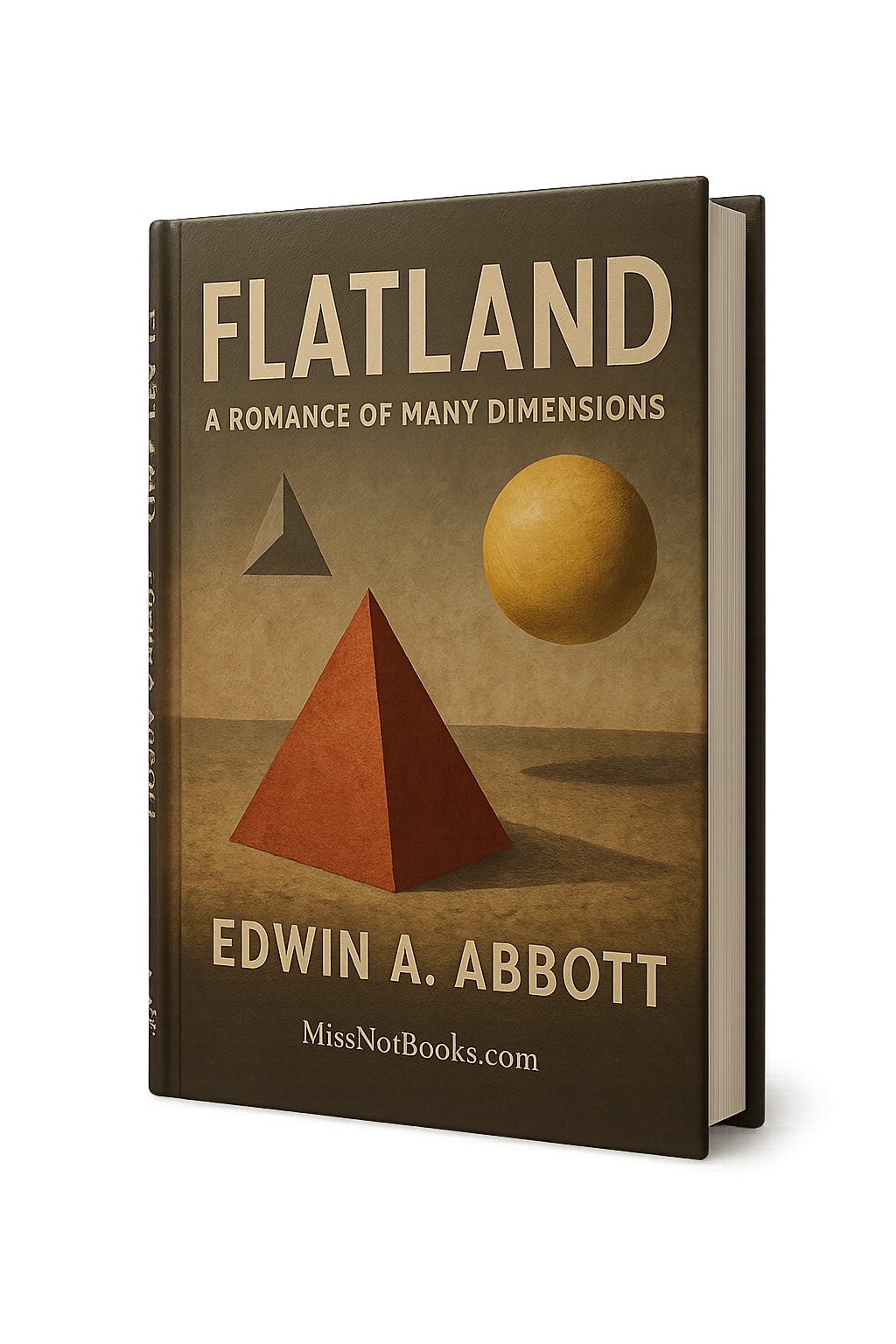
Flatland: A Romance of Many Dimensions
In an era marked by rigid two-dimensional thinking, one groundbreaking narrative emerged to challenge and transform our understanding of dimensions and existence. This book dares to venture beyond the surface of reality, compelling readers to consider the implicit structures of our world while questioning the limitations of perception. By introducing us to the notion of multiple dimensions, it provides a lens through which we can explore complex ideas in mathematics, society, and hierarchy. Its profound implications resonate not only with those interested in geometry but also with anyone grappling with philosophical concepts of reality and existence. Don’t miss the opportunity to engage with one of the most influential works of all time. Buy it today and explore the foundation of modern thought on dimensions and perception.
Core Ideas and Main Arguments
- Multidimensional Reality: Explores the idea that our perception is limited to three dimensions, while using a dimensional hierarchy to illustrate more complex realities.
- Social Commentary: Uses a fictional society to critique rigid social structures and class distinctions, suggesting that the inability to see beyond one's own dimensions can trap individuals in ignorance.
- Philosophical Exploration: Encourages readers to think critically about their own realities and to be open to perspectives beyond their immediate understanding.
- Mathematical Metaphor: Employs geometric analogies to make complex philosophical concepts accessible to the average reader, blending mathematics with narrative storytelling.
Author’s Intentions and Context
The author set out to challenge the conventional views of his time, where Victorian society was often constricted by rigid social norms and class distinctions. Responding to the cultural backdrop of late 19th-century England, the author aimed to inspire readers to embrace a broader view of reality. The book reflects an intellectual climate that was becoming more curious about the natural sciences while concurrently critiquing the ethical and social implications of such advancements. This work is a call to transcend the limitations imposed by society, urging readers to explore both scientific possibilities and societal reforms.
Structure of the Book
- Introduction to the World: Sets the stage in a two-dimensional universe, popularizing the narrative voice and perspective of its inhabitants.
- Revelation of the Third Dimension: Introduces the notion of a third dimension through the experience of the protagonist, offering a pivotal shift in understanding.
- Controversial Dialogues: Contains conversations that unpack complex ideas about social structures, reality, and the nature of perception.
- Conclusion: A reflection on the implications of understanding higher dimensions and the necessity for broader perspectives, emphasizing the need for intellectual humility.
Key Takeaways
- The Limitations of Perspective: Readers will grasp that our understanding is often bounded by our perception, shaped by societal norms.
- The Call for Open-mindedness: The text encourages a critical approach to challenging established norms and embracing the unknown.
- The Interplay of Mathematics and Reality: It illustrates the relationship between abstract concepts and their application to real-world scenarios.
Why It’s Important to Read
This book maintains its relevance in our continuously evolving understanding of dimensions and perspective. It serves as an invaluable resource for students of philosophy, mathematics, and social sciences, as well as general readers interested in the interplay between perception and reality. Its unique approach combines intellectual rigor with creative narrative, making it a timeless study that promotes curiosity and critical thinking.
Impactful Quotes and Analysis
-
“I am a simple creature of the plane, and I can but see and feel what is within my comprehension.”
This quote powerfully encapsulates the limitations of perception, immortalizing the struggle of an individual to expand beyond their understanding. -
“Oh! how I wish I could lift myself up from this flat world to see the whole of creation!”
This sentiment resonates deeply, capturing the yearning for knowledge and the profound sense of frustration tied to intellectual confinement. -
“To the inhabitants of Flatland, the possibility of three dimensions is beyond their grasp—just as we may struggle with the fourth dimension.”
This insight reflects on the barriers of understanding that define different levels of awareness across both literature and life.
About the Author
Edwin A. Abbott (1838-1926) was an English schoolmaster, theologian, and author known for his interest in social issues, education, and mathematics. Abbott's legacy is defined by his innovative approach that combined storytelling with complex ideas, making him a prominent figure in the discussion of dimensions and societal critique. His work has inspired countless thinkers and remains a cornerstone in the intersection of literature and mathematics.
This monumental work is Flatland: A Romance of Many Dimensions by Edwin A. Abbott, brought to you for educational purposes by MissNotBooks.com.