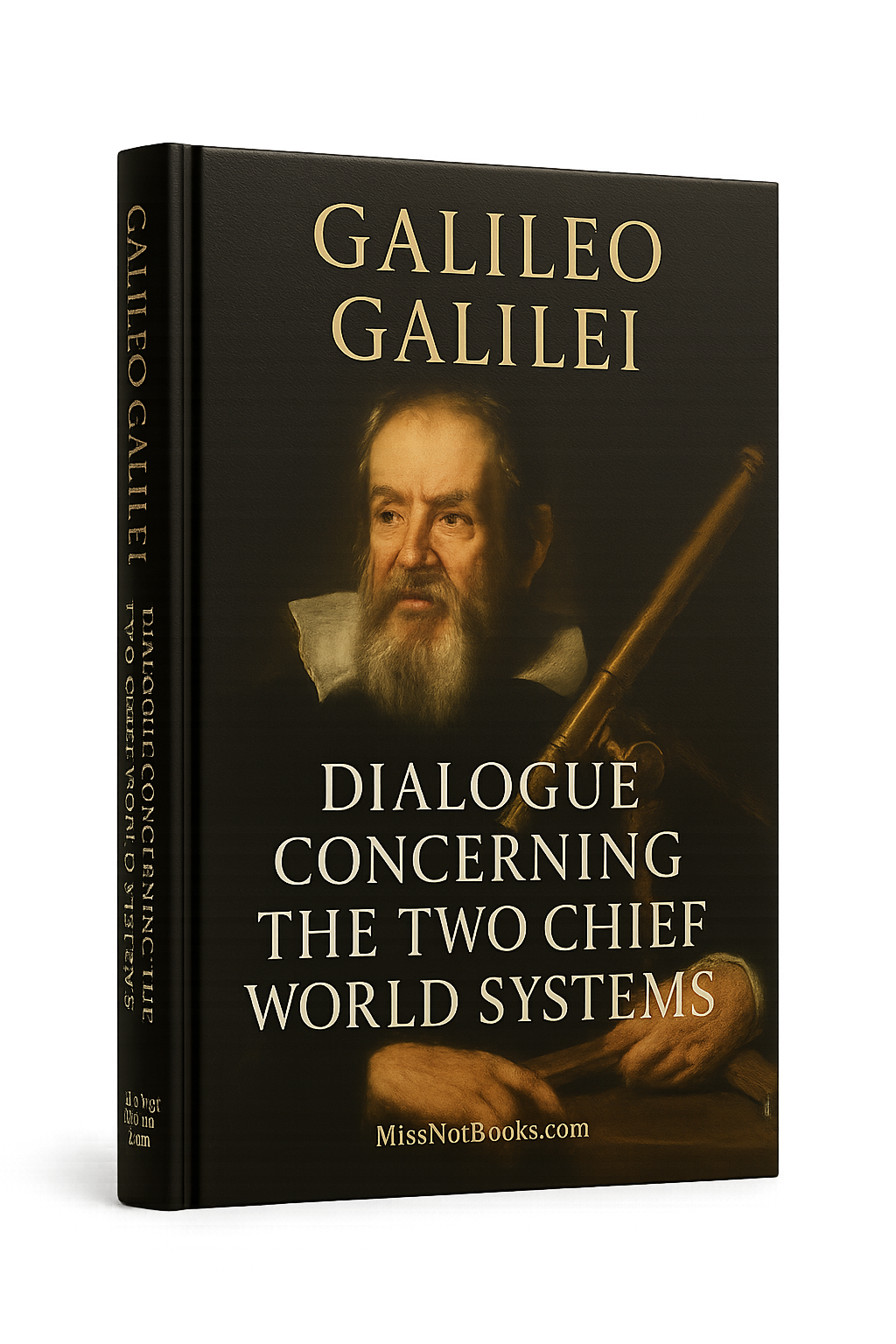
Dialogue Concerning the Two Chief World Systems
In an age marked by dogmatic thought and unquestioned traditions, a groundbreaking work emerged that not only transformed scientific inquiry but also laid the groundwork for modern philosophy and discourse. This book did not merely challenge existing paradigms; it provided a radical new lens through which the natural world could be understood, propelling humanity towards a future defined by empirical observation and rational thought. Its revelations not only illuminated the path for future generations of scientists but also incited profound philosophical debates that resonate to this day.
Don’t miss the opportunity to engage with one of the most influential works of all time. Buy it today and explore the foundations of modern scientific thought.
Core Ideas and Main Arguments
- Heliocentrism vs. Geocentrism: The book robustly defends the heliocentric model of the solar system, arguing that the Earth revolves around the Sun, countering centuries of dogmatic belief in geocentrism.
- Empirical Observation: It emphasizes the importance of observation and experimentation as the basis of scientific knowledge, challenging reliance on ancient texts and untested theories.
- Dialectic Method: Through its engaging dialogue format, the work illustrates the power of reasoned debate, inviting readers to question and scrutinize established beliefs.
- Critique of Authority: The author boldly critiques the limitations of Aristotelian physics and the philosophical status quo, advocating for a fresh perspective rooted deeply in observation.
Author’s Intentions and Context
The author sought to provoke thought and inspire a paradigm shift during a time when intellectual inquiry was stifed by rigid adherence to traditional teachings. Responding to both the scientific revolution and the theological debates of the early 17th century, the author aimed to demonstrate that faith and reason could coexist harmoniously, while also advocating for the validity of scientific reasoning. The work is a direct challenge to the intellectual authority of the Church and an urgent call to embrace inquiry as a path to truth.
Structure of the Book
The text is organized into a series of dialogues featuring three characters that discuss astronomy, physics, and philosophy, which allows complex ideas to be presented in a digestible format. Key parts include:
- Introduction of the Characters and Themes: Establishing the contextual foundation and initial arguments.
- Historical Observations: Delving into the contributions and errors of past thinkers.
- Detailed Exposition of the Heliocentric Model: Presenting empirical evidence and logical reasoning in support of heliocentrism.
- Concluding Reflections: Encouraging the pursuit of knowledge and the questioning of established truths.
Key Takeaways
- Rational Inquiry is Fundamental: The book champions the necessity of using reason as the key to unlocking understanding.
- Science and Religion Can Coexist: It proposes that empirical knowledge need not oppose spiritual beliefs but can enhance them.
- The Power of Dialogue: Engaging in discourse facilitates deeper understanding and critical thinking.
Why It’s Important to Read
This work remains profoundly relevant as it represents the spirit of inquiry that underpins contemporary scientific exploration. Readers from all walks of life—scientists, philosophers, and those interested in the evolution of human understanding—will find inspiration and insight about the importance of reasoned debate, skepticism, and the relentless pursuit of knowledge in the face of opposition. The intellectual courage exhibited in its pages is a testament to the human spirit that continues to drive innovation and enlightenment.
Impactful Quotes and Analysis
-
“The sun, with all those planets revolving around it and dependent on it, can still ripen a bunch of grapes as if it had nothing else in the universe to do.”
- This quote illustrates the profound connection between celestial mechanics and Earthly phenomena, emphasizing the elegance of a heliocentric universe.
-
“In questions of science, the authority of a thousand is not worth the humble reasoning of a single individual.”
- Here, the author underscores the power of individual inquiry over collective belief, a principle that remains central to scientific discourse today.
-
“Philosophy is written in this grand book, the universe; but it cannot be understood unless one first learns to comprehend the language and the characters in which it is written.”
- This metaphor highlights the importance of observation and interpretation in science, emphasizing that understanding the natural world requires rigorous study and engagement.
About the Author
Born in 1564, Galileo Galilei was an Italian astronomer, physicist, and polymath whose contributions laid the foundation for modern experimental science. Known as the "father of modern observational astronomy," Galileo's work not only challenged the scientific doctrine of his time but also sparked the scientific revolution, influencing countless thinkers and shaping the course of Western thought. His courageous commitment to empirical evidence and reason has left a lasting legacy that continues to inspire scientists and philosophers alike.
This monumental work is Dialogue Concerning the Two Chief World Systems by Galileo Galilei, brought to you for educational purposes by MissNotBooks.com.