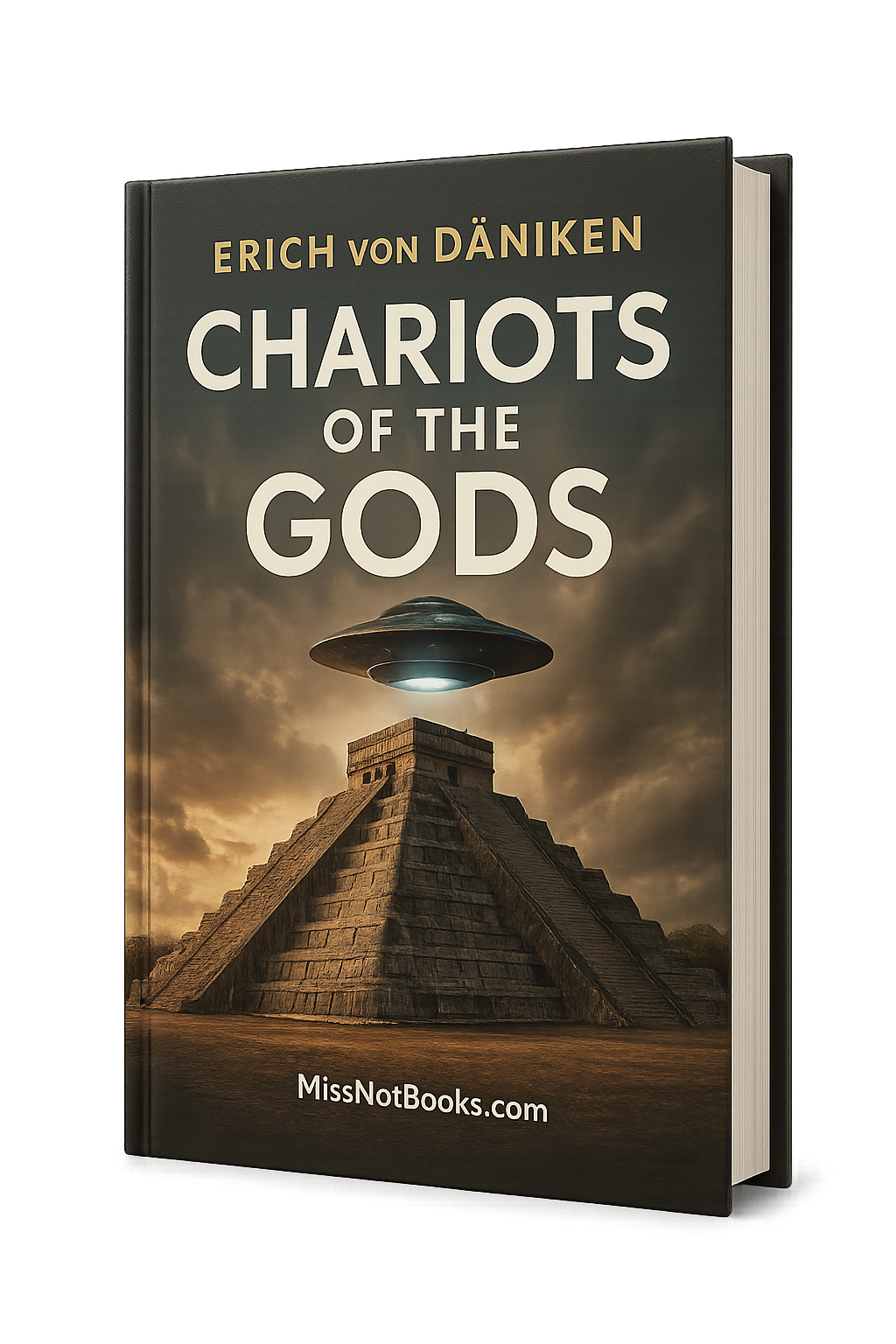
Chariots of the Gods
In a world tethered to the comforts of reason and empirical evidence, a groundbreaking book emerged that dared to transcend the boundaries of conventional thinking, igniting imaginations around the globe. By challenging the very foundation of human history and proposing radical alternatives to traditional narratives, this work delves into the age-old questions of human existence, our origins, and the mysteries of the cosmos. It revolutionized how we perceive the past by weaving together ancient myths, archaeological discoveries, and astronomical insights, prompting readers to reconsider the possibilities of extraterrestrial influences on early human civilizations.
Don’t miss the opportunity to engage with one of the most influential works of all time. Buy it today and explore the roots of our ancient history and the mysteries that lie beyond our planet.
Core Ideas and Main Arguments
- Ancient Astronaut Theory: Proposes that extraterrestrial beings visited Earth in ancient times and influenced the development of human culture and technology.
- Mythology as Evidence: Interprets myths of various cultures as historical accounts of alien encounters, offering a new perspective on legends and religious texts.
- Technological Anomalies: Highlights archaeological sites and artifacts that seemingly defy the technological capabilities of their eras, suggesting external guidance or intervention.
- Questioning Historical Narratives: Challenges traditional scholarly viewpoints regarding the achievements of ancient civilizations, from their construction techniques to their astronomical knowledge.
Author’s Intentions and Context
The author sought to provoke thought and discussion by presenting a vision of history that contrasts sharply with mainstream archaeology and anthropology. Emerging during the 1960s — a decade rife with cultural upheaval and scientific curiosity — this book responded to a growing public fascination with space exploration and the possibilities of life beyond Earth. The author aimed to inspire readers to rethink not just history but humanity's place in the universe, interrogating long-held beliefs about our past and our potential future.
Structure of the Book
- Introduction: Lays out the central thesis and the author's purpose.
- Chapters on Myth and Religion: Discusses various cultural texts and artifacts, analyzing their connections to extraterrestrial beings.
- Technological Exploration: Examines specific ancient sites and their implications for our understanding of past technologies.
- Conclusion: Reiterates the need for open-mindedness in historical interpretation and leaves readers questioning established narratives.
Key Takeaways
- The synthesis of mythology and history can yield a provocative understanding of human civilization.
- The book encourages skepticism of established historical paradigms and invites exploration of alternative explanations.
- Engaging with this work opens readers to consider the broader possibilities of life in the universe and the hidden histories that may lie beyond our current understanding.
Why It’s Important to Read
This book remains a pertinent read for anyone intrigued by the intersection of history, archaeology, and the uncharted realms of space. Whether you are a student of history, a science enthusiast, or simply a curious mind, this work invites you to challenge conventions and expand your understanding of humanity's past and future. For those open to the extraordinary, it offers a tantalizing glimpse into the possibilities that transcend traditional historical narratives.
Impactful Quotes and Analysis
-
“The Earth is a cradle of humanity, but mankind cannot remain in the cradle forever.”
- This quote encapsulates the idea that humanity must look beyond our planet and consider our place within the cosmos, urging us to ponder whether our evolution is part of a larger narrative.
-
“Legends are often rooted in truth, waiting for mankind to discover their significance.”
- Here, the author suggests that the stories shared through generations may hold truths lost to time, encouraging readers to investigate the deeper meanings behind ancient tales.
-
“We must break free from the shackles of traditional thought to explore the possibilities of what we do not yet know.”
- This powerful statement serves as a rallying cry for intellectual freedom, inviting people to embark on a journey of discovery that lies outside established norms.
About the Author
Erich von Däniken (born April 14, 1935) is a Swiss author and a key figure in the development of the ancient astronaut theory, which posits that extraterrestrial beings have influenced human history. His controversial writings have sparked extensive debate in both popular and academic circles, positioning him as a pivotal character in discussions about the intersections of mythology, archaeology, and alien speculation. His legacy endures as he continues to inspire curiosity about human origins and our place in the universe.
This monumental work is Chariots of the Gods by Erich von Däniken, brought to you for educational purposes by MissNotBooks.com.